Why Your Anchor Point Keeps Drifting (And the One-Session Fix)
Quick Answer: Anchor point drift is almost always caused by relying on visual memory of hand position instead of a consistent physical touch reference — adding one specific, repeatable touch point (like string-to-nose or thumb-to-jaw) fixes it faster than any amount of conscious repetition alone.
Your groups were tightening up, and now shots are scattering again for no obvious reason. Before assuming your form has broken down entirely, check whether your anchor point has quietly started drifting.

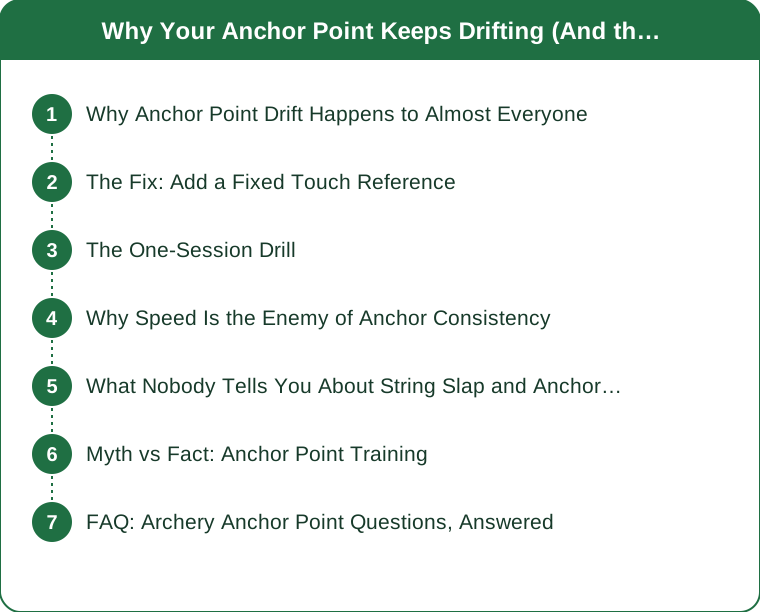
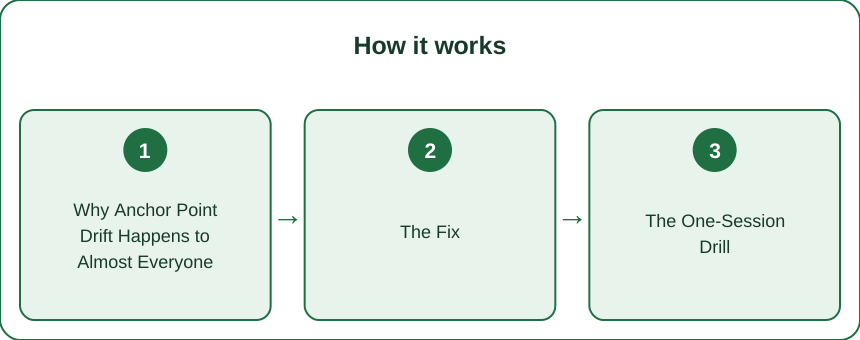
Why Anchor Point Drift Happens to Almost Everyone
Most archers initially learn anchor point through visual feel — ‘about here, near my cheek’ — which works until fatigue, changed lighting, or simple inconsistency in draw sequence shifts that felt position slightly. Because the drift is small each time, it’s rarely noticed shot to shot, only in the cumulative group spread over a session.
The Fix: Add a Fixed Touch Reference
Pick one specific physical touch point that doesn’t rely on visual judgment — string touching the tip of your nose, or a specific knuckle contacting your jawline — and make reaching that exact touch, every single time, the actual trigger for your release, not a ‘close enough’ feeling.
The One-Session Drill
Draw to anchor and hold for 3 full seconds before releasing, explicitly checking your touch reference each time rather than releasing as soon as it feels roughly right. Do this for 20-30 slow, deliberate shots in one session — this deliberate slowing down is what recalibrates the muscle memory that’s drifted.

Why Speed Is the Enemy of Anchor Consistency
Rushing the draw-to-release sequence is one of the most common ways drift creeps back in, because a rushed anchor skips the moment of actually confirming touch contact. Slowing down for a dedicated practice session, even if it feels tediously careful, resets the habit more effectively than shooting more volume at normal speed.
What Nobody Tells You About String Slap and Anchor Drift
A shifting anchor point often changes your face’s position relative to the string just enough to explain sudden string slap on the forearm that wasn’t happening before — if slap starts appearing out of nowhere, check anchor consistency before adjusting your arm guard or stance.
Myth vs Fact: Anchor Point Training
Myth: A coach has to fix anchor drift for you. Fact: a fixed touch reference and deliberate slow-shot drilling can self-correct most drift without needing hands-on coaching, though a coach can help confirm the touch point is anatomically sound for your draw.
Myth: Once you find your anchor, it’s permanent. Fact: anchor point can shift with changes in equipment, draw weight, or even significant changes in body composition — periodic rechecking is normal, not a sign of failure.
FAQ: Archery Anchor Point Questions, Answered
How do I know if my groups are opening up due to anchor drift specifically?
If your groups are spreading in a scattered, inconsistent pattern (not a clear directional bias), anchor drift is a likely cause worth checking before adjusting sight or stance.
Should beginners worry about anchor point right away?
Yes, ideally from very early on — anchor point habits form fast, and an inconsistent one is much easier to prevent than to correct later.
Does anchor point differ between recurve and compound bows?
Yes — compound bows with let-off and a mechanical release tend to have more forgiving anchor consistency than recurve, where the anchor point is doing more of the consistency work.
TL;DR:
- Anchor drift usually comes from relying on visual feel instead of a physical touch reference
- Pick one specific, repeatable touch point (nose, jaw, knuckle) as your real anchor trigger
- Run a slow, deliberate 20-30 shot session, holding 3 seconds and checking touch each time
- Sudden string slap can be a symptom of anchor drift, not just an arm guard issue
Scattering groups after a period of tight shooting is often a small, invisible drift rather than a form collapse — a single focused session rebuilding your touch reference usually brings it back faster than you’d expect.
Keep Reading
This article is for general informational and styling purposes only. Fit, sizing, and product availability may vary.