Why Your Anchor Point Drifts Late in a Session and Groups Open Up
Quick Answer: As your draw-side muscles fatigue, your hand settles into a slightly different place on your face - usually lower and further back - and because the anchor is your rear sight, a two-millimetre change there moves the arrow noticeably downrange. The fix is not more strength endurance in the short term; it is a hard anchor with two contact points rather than one, a shot count limit that stops before the drift begins, and a rest structure that keeps the draw fresh.
First end, tight group. Second end, tight group. Somewhere around the fifth or sixth end everything opens up, drops low, or starts stringing vertically, and you spend the rest of the session chasing form problems that were not there an hour ago.
This is one problem with a specific mechanism.
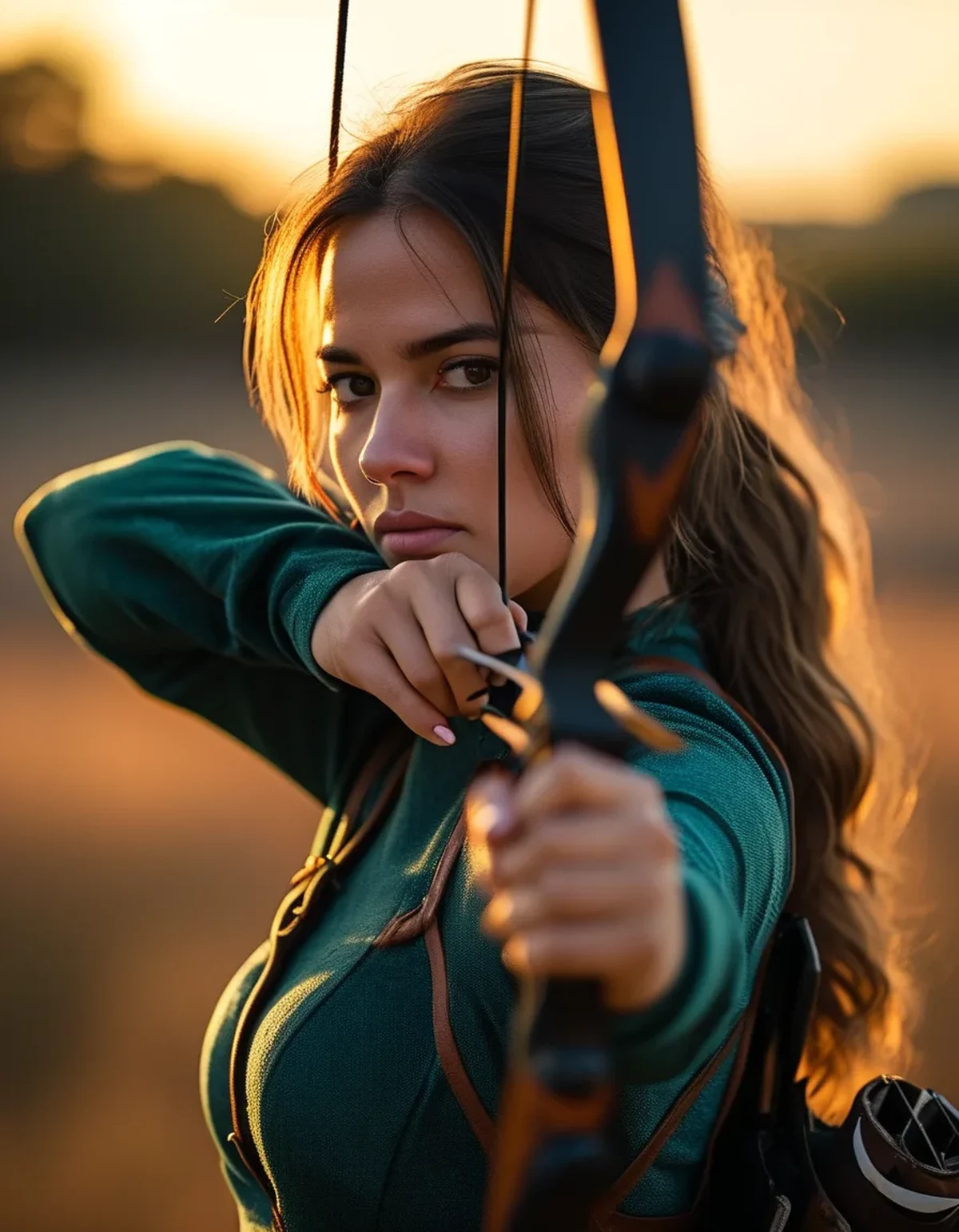
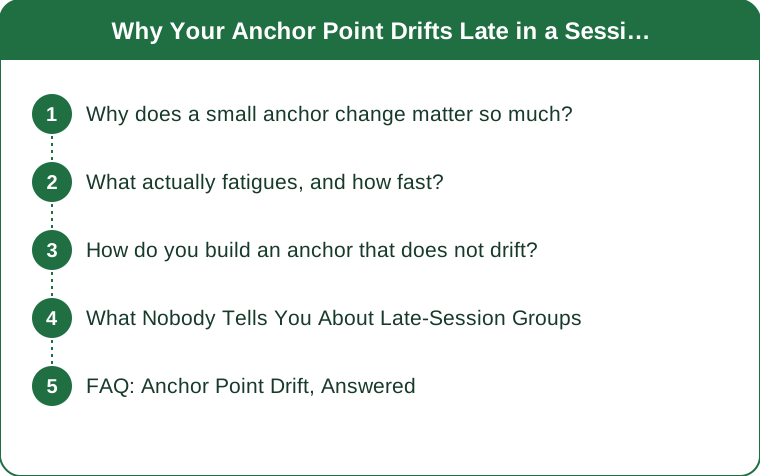
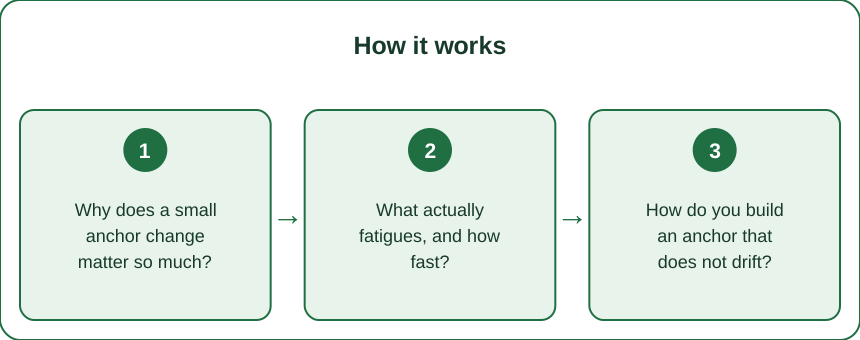
Why does a small anchor change matter so much?
Because the anchor is functionally your rear sight, and rear sights work on angles. With a bow sight at the riser and your anchor at your face, the distance between them is roughly the same as a rifle’s sight radius. Move the rear reference by two millimetres and the change at 20 metres is many times larger.
Vertical drift is the most common and the most costly. A hand that settles lower on the jaw raises the arrow’s launch angle relative to your sight picture and typically sends arrows high, or produces vertical stringing as the anchor wanders between shots.
Horizontal drift comes from the hand moving further back or the string touching the face differently. A string that moved off the nose or the corner of the mouth changes the alignment plane and pushes groups sideways in a way that looks exactly like a windage error.
Draw length changes with it. A hand that creeps back adds draw length, adds stored energy, and raises arrow speed slightly. The point of impact moves and the tune shifts - which is why people start blaming the arrows.
And the reason it goes unnoticed is that it feels correct. Fatigued muscles find the path of least resistance, and that new position feels like a comfortable anchor rather than a wrong one. Nothing in the sensation flags the change.
What actually fatigues, and how fast?
The rear shoulder and mid-back do the holding work, and they tire before your fingers or arms do. Rhomboids, mid and lower trapezius, and the posterior deltoid hold the draw, and when they fade the scapula slides forward slightly - which brings your draw hand forward and down.
The timeline is more predictable than people expect. For most recreational archers, the first noticeable drift arrives somewhere between shot 40 and shot 70 in a session, and the second, larger drop comes at roughly shot 90 to 120. If your groups fall apart at end six every single time, that number is your current limit, not a form flaw.
Bow weight matters more than total volume. A bow at the top of your comfortable range compresses that timeline substantially - shooting five pounds lighter can push the drift point back by twenty or thirty shots.
Rest length between ends matters as much as shot count. Two minutes between ends allows meaningful recovery in those postural muscles; forty seconds does not. People who shoot alone tend to rest less and drift earlier, without connecting the two.
And cold makes it arrive sooner. Autumn sessions on a cold range fatigue faster, because muscles working at lower tissue temperature are less efficient and grip tension rises - which is why September groups often look worse than August ones on the same bow.
How do you build an anchor that does not drift?
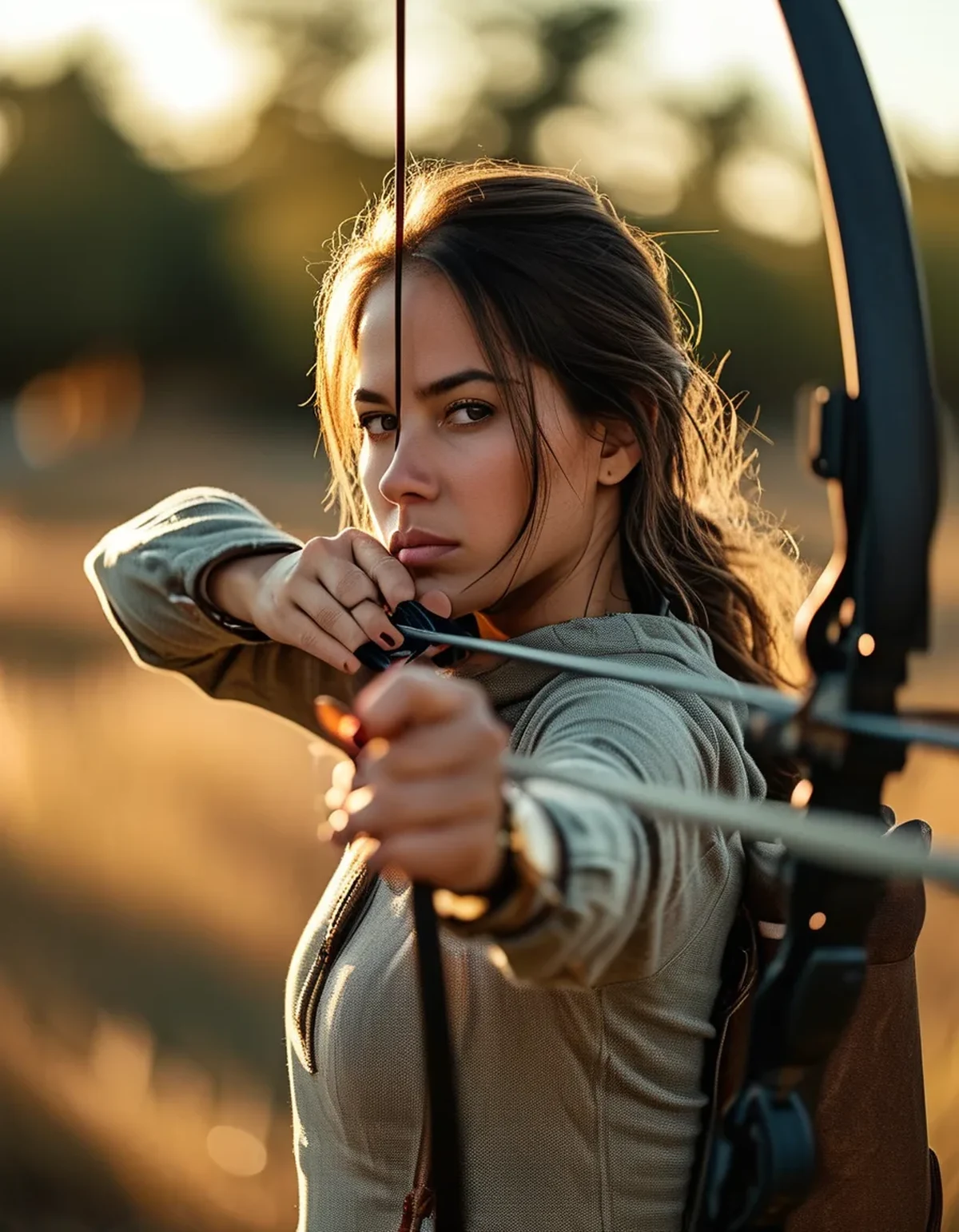
Use two contact points, not one. A single reference - hand against jaw - lets the hand slide along it. Two references that cannot both be wrong at once - for example, index finger under the jawbone plus the string touching the tip of your nose - constrain the position in a way a single point cannot.
Add a kisser button or use the string-to-nose contact deliberately. The point of a third reference is to make a wrong anchor feel wrong, which is exactly what fatigue removes. Most drift problems disappear once a positive tactile check exists.
Check the contact consciously on every shot for two weeks. Draw, anchor, verify both points, then aim. This feels slow and mechanical and it builds the habit that later runs automatically. Skipping the verification is how the drift returns.
Have someone film you from the side at the start and end of a session. Two clips at the same zoom, played side by side, will show a drift you cannot feel. This is the fastest way to confirm what is actually happening rather than guessing.
And stop the session before the drift, not after it. If your limit is shot 60, shoot 50 good ones. Practising through the drift teaches the drifted position, which is the opposite of what you want and is why some people’s problem gets worse the more they practise.
What Nobody Tells You About Late-Session Groups
The last two ends of a session teach you more than the first two, and not in a good way. Repetition builds the pattern you repeat, so the shots you take while fatigued are being learned with the same enthusiasm as the good ones. Volume for its own sake is not neutral.
Most people are overbowed by about five pounds and would shoot better immediately with less. The drift point is heavily driven by draw weight, and dropping five pounds usually extends a session by twenty or more good shots. It feels like a step backwards and it is not.
Blank bale shooting at the end is better than more scored ends. If you want extra volume after your quality shots are done, shoot close to a blank target with your eyes on your form rather than a face. You get repetitions without teaching yourself to chase a group with a drifted anchor.
Strength work fixes it, but on a two to three month clock. Rows, face pulls, and scapular retraction work genuinely extend the drift point, and they do it slowly. In the meantime, manage the session rather than waiting for the strength.
And the surprising one: hydration and food have a visible effect on late-session groups. A two-hour session on an empty stomach produces a steeper drop-off, and archers routinely attribute that to concentration when it is straightforwardly fuel. Something to eat between ends four and five is not a small intervention.
FAQ: Anchor Point Drift, Answered
Why do my arrows go high at the end of a session?
Most often the draw hand has settled slightly lower on the face as the rear shoulder fatigues, which raises the launch angle relative to your sight picture. Check it with side-on video at the start and end of a session rather than adjusting your sight.
How many arrows should I shoot in a practice session?
Shoot to the point where your groups are still consistent, and stop there. For most recreational archers that is 40 to 80 quality shots. If you want more volume, add blank bale work rather than more scored ends.
Is my bow too heavy if my form breaks down late?
Probably. A useful test is whether you can draw, hold for ten seconds, and let down under control three times in a row without your form changing. If not, five pounds lighter will almost certainly improve your scores.
Does a kisser button really help consistency?
Yes, for exactly this problem. It provides a positive tactile reference so a drifted anchor feels wrong rather than merely being wrong. Any second or third contact point does the same job - the string on the nose works well and costs nothing.
TL;DR:
- Your anchor is your rear sight, so a two-millimetre change there produces a large change downrange - most often arrows high or vertical stringing.
- The rear shoulder and mid-back fatigue first, and the scapula slides forward, bringing the draw hand forward and down.
- Most recreational archers see first drift between shot 40 and 70, and draw weight compresses that timeline more than anything else.
- Build two or three contact points so a wrong anchor feels wrong, verify them consciously for two weeks, and film side-on at the start and end of a session.
- Stop before the drift rather than shooting through it - practising fatigued repetitions teaches the drifted position.
If your groups fall apart at the same end every session, that is not a form problem. That is your current shot count, and it is a number you can plan around.
Keep Reading
This article is for general informational and styling purposes only. Fit, sizing, and product availability may vary.