How to Restart Archery Form After a Layoff Without Rebuilding Bad Habits
Quick Answer: After three or more weeks off, your draw-specific strength has dropped more than your technique has, and shooting at your old poundage forces compensations that stick fast. Drop the draw weight by roughly 20 to 25 percent for the first two sessions, shoot blank bale at close range with no target face for the first hundred arrows, and rebuild in the order muscles-then-sequence-then-aiming. Scoring anything in the first session is the mistake that costs you the autumn.
The first end felt fine. It was the fourth that told the truth, and by then you had already shot forty arrows teaching yourself something you will spend six weeks unteaching.

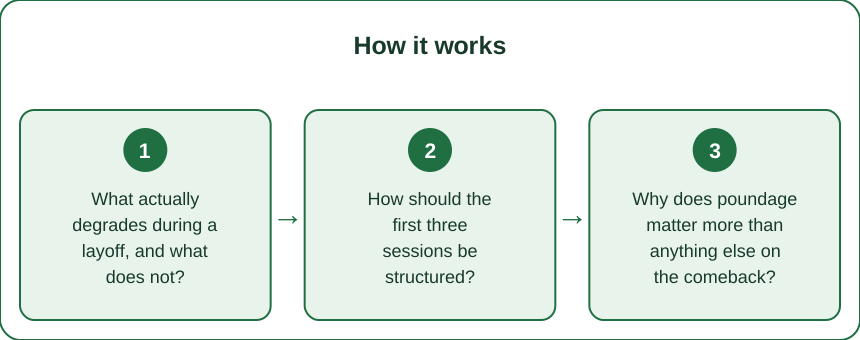
What actually degrades during a layoff, and what does not?
Draw-specific endurance falls fastest. The back and shoulder muscles that hold a draw are trained by a very particular isometric demand that almost nothing else replicates. Two to three weeks off produces a noticeable drop in how many arrows you can shoot before form deteriorates, even when general fitness is unchanged.
Technique itself is remarkably durable. Motor patterns built over years do not evaporate in a month. The first few arrows after a break usually feel surprisingly normal, which is precisely the trap - the pattern is intact and the strength to execute it repeatedly is not.
Timing and rhythm degrade in the middle. The subtleties - the pace of the expansion, the consistency of the release, the length of the follow-through - drift more than the gross positions do. These are also the elements that decide group size, which is why groups open up while the shot still feels correct.
Your anchor point tends to move slightly and you will not feel it. Small changes in head position and hand placement creep in during a break, and they are invisible from inside the shot. A phone on a tripod recording from the side for one end is worth more here than any amount of introspection.
And the mental clock resets. The shot process that ran automatically now needs conscious attention, which lengthens the time at full draw, which is exactly the demand your strength is currently short of. This interaction is why the fourth end falls apart while the first felt fine.
How should the first three sessions be structured?
Session one: blank bale only, reduced poundage, sixty to eighty arrows maximum. Stand close enough that you cannot miss the target butt, and remove the face entirely. No aiming, no scoring, no group assessment. The single objective is a clean repeatable sequence with the eyes closed for at least part of it.
Drop the draw weight by a fifth to a quarter. On a recurve with limb bolts, back them out. On a compound, either reduce the draw weight properly or use a lighter backup bow. If neither is possible, cut the arrow count hard instead - about half your normal volume - and stop at the first sign of form breaking down.
Session two: blank bale for the first thirty arrows, then a target face at short distance. Still no scoring. Watch for one thing only: whether the shot sequence stays identical when a target face appears. For most returning archers it does not, and the difference is the whole lesson.
Session three: normal distance, still reduced poundage, still no score. Group size will be worse than you remember and this is not information about your technique yet. It is information about the poundage and the recency, both of which are temporary.
Return to full poundage at session four or five, not before, and add scoring only after that. The temptation to test yourself is the strongest at exactly the moment when testing produces the least useful data and the most durable bad habits.
Why does poundage matter more than anything else on the comeback?
Because every compensation you can name comes from being slightly overbowed. Creeping forward at full draw, collapsing on release, hunching the shoulder, gripping the bow hand, snatching the release - all of them appear when the draw exceeds what the back can comfortably hold for the duration of the shot process.
And compensations learned under fatigue are learned fast. The nervous system is efficient about finding a way to complete the task. Ten ends of shooting slightly overbowed teaches a workaround that then persists after the strength returns, which is why archers often shoot worse three weeks after a comeback than in the first week.
The reduction feels absurd and that is the correct feeling. A 20 percent drop makes the bow feel like a toy for about fifteen arrows, and then it feels normal, and then you notice you are still shooting cleanly at arrow sixty where you would previously have collapsed at forty.
A specific test to know when to go back up: you should be able to shoot your full planned session volume with the last end looking like the first on video. Not feeling like it - looking like it. Until that is true, the poundage stays down.
And build the strength separately rather than through arrows. Band work, a lightweight training bow, or simple rows and face pulls two or three times a week rebuilds the specific endurance far faster than shooting does, and without the risk of teaching yourself anything on the way.
What changes about shooting outdoors in September?
Light drops earlier and gets flatter, and sight pictures change with it. A sight picture calibrated in July’s high overhead light reads differently under a low September sun, and the difference in perceived aiming point is real enough to shift a group vertically.
Cooler air is denser, which slightly slows arrow flight - the effect is small at short distances and becomes measurable at longer ones. Expect to re-verify sight marks rather than assuming last season’s are still correct, particularly at 50 metres and beyond.
Cold hands change the release before you notice them. The release is the most sensitive element in the shot and it degrades with reduced finger sensitivity. A pocket warmer between ends is not fussiness, it is form maintenance, and it matters more for finger shooters than for release aid users.
Clothing changes the string clearance. The extra layer that appears in late September is the most common cause of a sudden mysterious left-or-right shift, because the string catches the chest or the sleeve. Check it deliberately at the first cool session rather than diagnosing it as a form fault three weeks later.
And warm-up needs to be genuinely longer. Cold shoulders and cold back muscles under an isometric hold is how comeback sessions turn into rotator cuff complaints. Ten minutes of band work and progressively increasing draws before the first arrow, minimum, once the mornings turn.
FAQ: Returning to Archery After a Break
How much draw weight should I drop after time off?
About 20 to 25 percent for the first two or three sessions after three or more weeks away. Go back up only when you can shoot your full intended arrow count with the last end looking, on video, like the first one.
How long does it take to get archery form back?
Technique usually returns within one or two sessions; draw-specific endurance takes roughly two to four weeks of consistent shooting to rebuild after a month off. The gap between those two timelines is what causes most comeback problems, because the shot feels right long before you can repeat it reliably.
Should I shoot blank bale when coming back to archery?
Yes, and more of it than feels necessary. The first sixty to eighty arrows with no target face let you rebuild the sequence without the aiming instinct pulling the shot process out of order. It is the cheapest insurance against learning a compensation.
Why are my groups worse after a break even though the shot feels the same?
Because the elements that decide group size - timing, expansion pace, release consistency, follow-through - degrade more than the gross positions do, and none of them are easy to feel. Film one end from the side; the difference is usually visible immediately even when it is not perceptible from inside the shot.
TL;DR:
- Draw-specific endurance drops far faster than technique, which is why the first end feels fine and the fourth does not.
- Drop the poundage 20 to 25 percent for two or three sessions - being slightly overbowed is the source of nearly every comeback compensation.
- Session one is blank bale only, close range, no target face, no scoring; add the face at session two and the distance at session three.
- Go back to full poundage only when the last end looks like the first on video, and add scoring after that.
- Rebuild the strength off the bow with bands and rows, which is faster and teaches you nothing bad.
- Autumn specifics: re-verify sight marks in cooler denser air, check string clearance on the first layered session, and warm up for a full ten minutes.
Spend the first session shooting nothing that counts, and the rest of the autumn counts for more.
Keep Reading
This article is for general informational and styling purposes only. Fit, sizing, and product availability may vary.