Why Your Archery Anchor Point Keeps Drifting — and the Muscle Memory Fix
Quick Answer: Anchor point drift usually comes from fatigue changing your draw hand position shot to shot, not from aiming errors — building a consistent, tactile anchor reference (like string-to-nose-tip contact) fixes it faster than focusing on aim alone.
You’ve tightened your grip, checked your stance, and your groups still spread wider than they should. Before troubleshooting aim, it’s worth checking something more basic: whether your anchor point — where your draw hand consistently lands at full draw — is actually landing in the same spot every single shot.

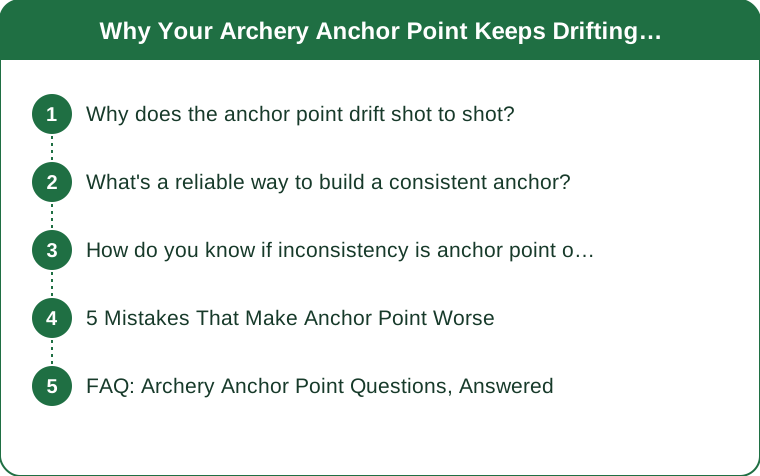
Why does the anchor point drift shot to shot?
Mostly fatigue — as forearm and back muscles tire across a session, the draw hand tends to creep slightly, landing in a marginally different spot without you consciously noticing.
This is especially common in the later shots of a session, which is exactly when many archers blame their aim instead of recognizing the anchor itself has shifted.
What’s a reliable way to build a consistent anchor?
Use multiple tactile reference points, not just one — string touching the tip of the nose, draw hand thumb knuckle under the jaw, and index finger corner-of-mouth contact, all checked together every single shot.
A single reference point (like ‘hand near my cheek’) is too vague to be consistent; 3 simultaneous tactile checkpoints give your body a much more precise, repeatable target.

How do you know if inconsistency is anchor point or something else?
Video your form from the side for 10 shots and freeze-frame at full draw each time — compare draw hand position across frames. If it’s visibly shifting, that’s your answer.
If the anchor position looks consistent on video but groups still spread, the issue is more likely release technique or bow torque, not anchor point specifically.
5 Mistakes That Make Anchor Point Worse
1. Only checking anchor at the start of a session, not monitoring it as fatigue builds later on.
2. Using a single vague reference instead of multiple specific tactile checkpoints.
3. Rushing the draw, which skips the moment where anchor position gets consciously confirmed.
4. Ignoring grip fatigue as a root cause and focusing entirely on aim instead.
5. Not video-checking form periodically, missing drift that’s invisible from the shooter’s own perspective.
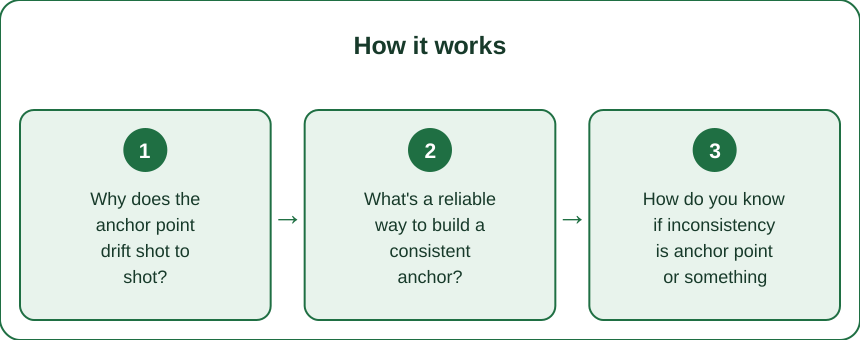
FAQ: Archery Anchor Point Questions, Answered
How many tactile reference points should a good anchor have?
Most coaches recommend at least 2-3 simultaneous checkpoints (like nose, chin, and mouth corner contact) rather than relying on a single reference.
Does anchor point drift more in longer practice sessions?
Yes — fatigue-related drift tends to increase in the later portion of a session, which is why periodic form checks throughout, not just at the start, matter.
Can a clicker or draw-check tool help with anchor consistency?
Yes, mechanical draw-length indicators (clickers) provide an objective, fatigue-proof signal for full draw position, which can reinforce anchor consistency alongside tactile checkpoints.
TL;DR:
- Anchor drift is usually fatigue-driven, worsening later in a session, not an aiming problem
- Use 2-3 tactile reference points together, not one vague spot
- Video-check form periodically to catch drift invisible from the shooter’s own view
- A clicker or draw-check tool adds an objective, fatigue-proof anchor signal
Tight groups start with a repeatable anchor — chasing aim adjustments without fixing anchor drift rarely closes the gap.
Keep Reading
This article is for general informational and styling purposes only. Fit, sizing, and product availability may vary.