How Cold Weather Quietly Changes Your Archery Form
Quick Answer: Cold changes three things at once — your bow’s limbs and string behave slightly differently, your muscles are less compliant and your hands less sensitive, and your added layers change your anchor and string clearance. Most cold-weather group shifts come from the third, not the first. Before you adjust your sight, shoot a few ends in the exact clothing you’ll compete in and see whether the problem is your gear or your jacket.
The first genuinely cold range day arrives and your arrows aren’t where they were. Slightly low, maybe left, and inconsistent in a way that feels new.
The reflex is to start turning the sight. That’s usually the wrong first move, because the most likely culprit is what you’re wearing.
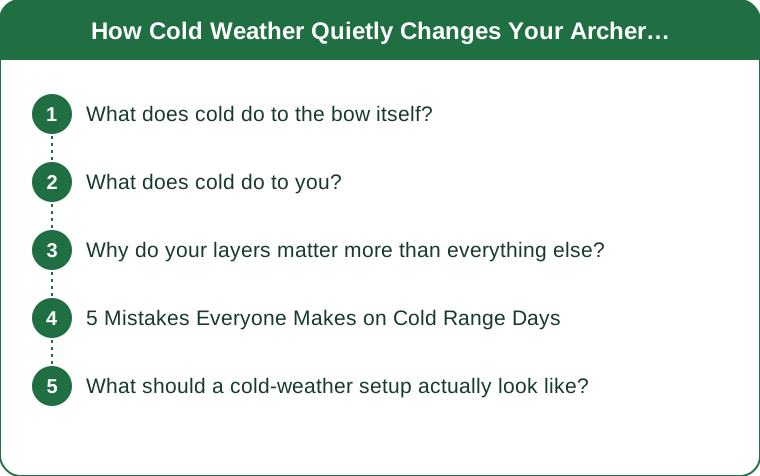
What does cold do to the bow itself?
Real, but smaller than most archers assume.
Limbs get marginally stiffer in cold, which can add a very small amount of draw weight and slightly increase arrow speed. On a modern bow this effect is usually not large enough to explain a visible group shift on its own.
Strings and cables are more interesting. Synthetic string materials can contract slightly in cold, which can effectively shorten the string and change brace height and timing by small amounts. On a compound, timing changes are the ones worth watching, because they affect where the arrow leaves.
Arrow spine behaves dynamically differently with a small change in bow output, though again the magnitude is modest across a 40-degree temperature swing.
Lubricants and cam bearings thicken. This is more relevant on very cold days and mostly shows up as a slightly different feel through the draw cycle rather than a point-of-impact change.
Sum it up honestly: bow effects exist and are worth knowing about, and they are usually the smallest of the three factors. If your group moved four inches at 20 yards, the bow didn’t do that.
What does cold do to you?
More than it does to the bow.
Muscles are less compliant when cold, which means your draw feels heavier and your back tension is harder to find. The muscles that hold the shot together — the mid-back and rear shoulder — are exactly the ones that go stiff first, and stiff means you’ll tend to muscle the shot with your arms instead.
Hand sensitivity drops sharply. This is the underrated one. Your release depends on fine sensation in your fingers or on a consistent feel through a release aid. Cold fingers give you dramatically less feedback, which produces inconsistent releases that feel identical to you. The arrows will tell you what your hands can’t.
Shivering — even the low-level tension before actual shivering — destroys the stillness that a good shot requires. It shows up as increased float and a wandering sight picture.
Reaction to cold is cumulative. Your first three ends are fine. By end eight your hands have cooled and your groups open. This is why cold-weather scores often decline through a session in a way warm-weather scores don’t.
What to do: a genuinely longer warm-up, hand warmers in a pocket between ends, and a shorter session with more attention rather than a long one with degrading form.
Why do your layers matter more than everything else?
Because they change the geometry of the shot, and geometry is what a bow measures.
Three specific problems:
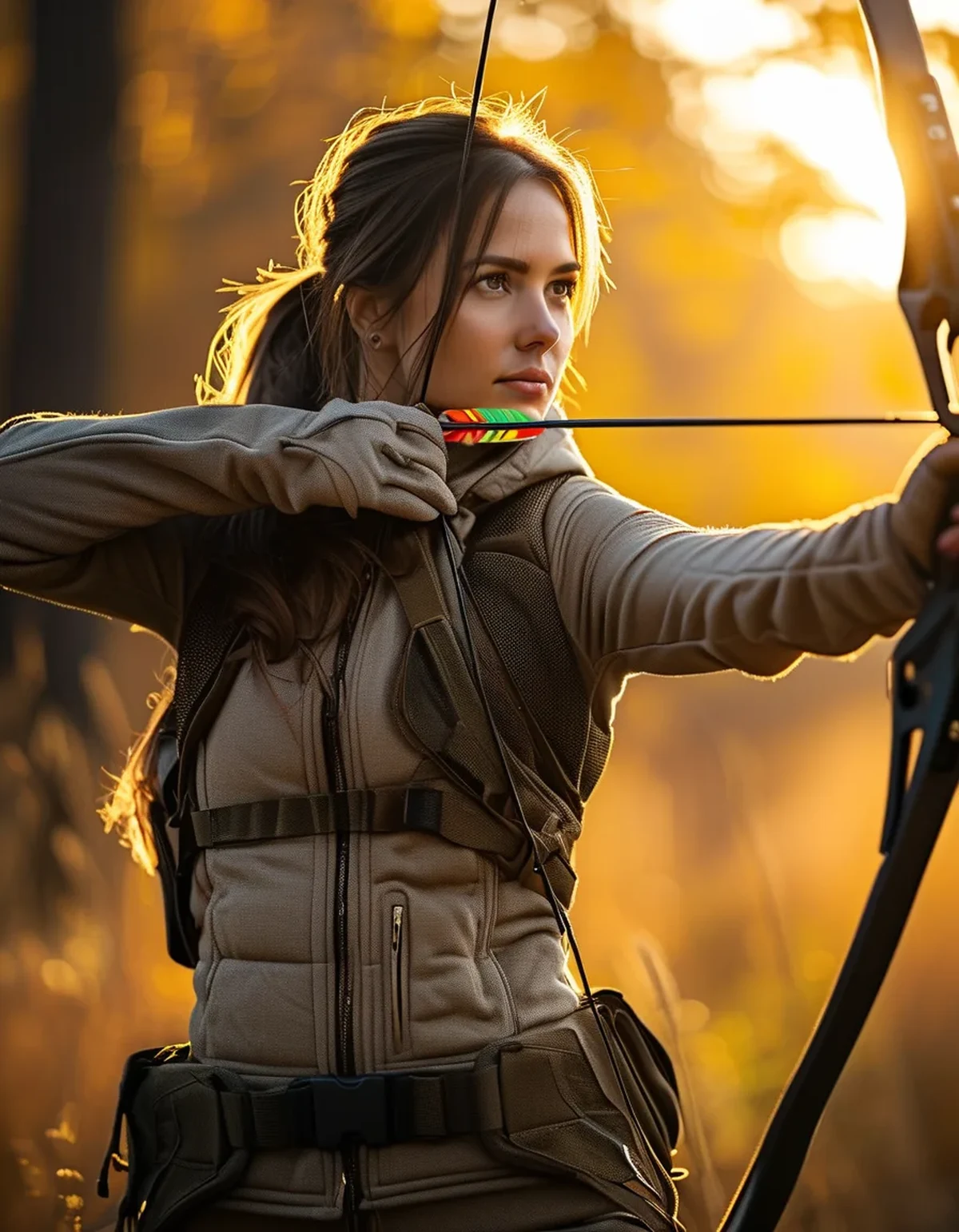
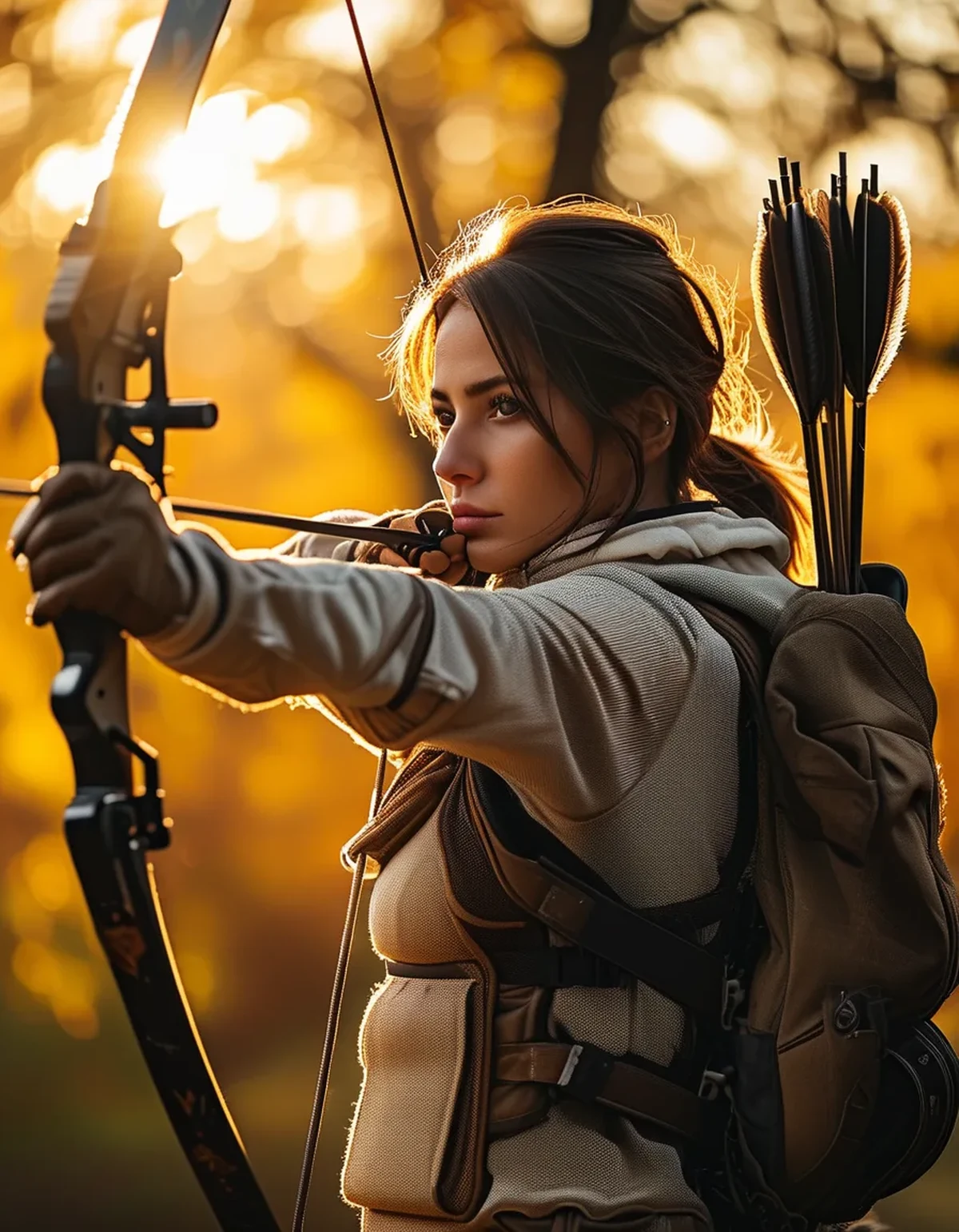
String clearance at the chest and arm. A bulky jacket puts fabric where the string wants to travel. Even light contact deflects the string and sends the arrow off — usually left for a right-handed archer, and inconsistently, depending on how the fabric sits that particular shot. This is the single most common cold-weather group shift and it’s entirely fixable.
Anchor point. A hood, a raised collar, or a thick sleeve at the shoulder changes where your hand lands on your face. A quarter-inch of anchor change is a meaningful vertical shift downrange.
Bow arm and shoulder position. A thick layer at the shoulder subtly changes how your bow shoulder sets, which changes your draw length by a small amount, which changes your point of impact.
The diagnostic is straightforward and worth doing before touching a single adjustment: shoot one end in the jacket, then take the jacket off and shoot an identical end. If the groups move, your clothing is the variable. If they don’t, look at the bow.
The fix isn’t shooting cold. It’s choosing the right layers: slim on the string side, warmth built with a compressible base layer rather than a bulky shell, and an arm guard that runs longer than your summer one to flatten sleeve fabric against your forearm.
5 Mistakes Everyone Makes on Cold Range Days
1. Adjusting the sight before diagnosing. You’ll chase the sight all winter and then have to undo it in spring. Diagnose first — jacket off, one end, compare.
2. Skipping the warm-up because it’s cold and you want to start. This is exactly backwards. Cold days need a longer warm-up, not a shorter one, and a few draws with a lighter band before the first end is worth more than it costs.
3. Wearing gloves that fit the hand but not the release. A glove that changes your finger contact or your release feel is a bigger problem than cold fingers. Better answer: bare or thin-gloved hands for the shot, with a warm pocket or a hand warmer between ends.
4. Leaving the bow in the car overnight. A bow that’s at 25°F when you start and 45°F by end six is a moving target. Let it stabilize to ambient temperature before your first scoring end, and store it inside when you can.
5. Shooting the same session length as summer. Cold degrades form progressively through a session, so the last third of a long winter practice is often actively teaching you bad habits. The fourth point on this list is the one that fools even experienced archers, because a cold bow feels perfectly normal in the hand — the change shows up only in the arrows.
What should a cold-weather setup actually look like?
Practical, from the string side out:
Base layer: thin, close-fitting, on both arms and chest. This is where warmth comes from. A good base layer under a light shell is warmer and slimmer than a single thick jacket.
Chest side: as flat as you can make it. Some archers use a chest guard specifically in winter for exactly this reason — it compresses layers on the string side and gives the string a predictable surface. If you’ve never used one, cold season is the argument for trying it.
Arm guard: longer than your summer one, covering more of the forearm and flattening the sleeve.
Hands: thin gloves or a shooting glove that doesn’t alter your release, plus a hand warmer in a pocket you use between every end. Fingerless mitts with a fold-over top are a good compromise.
Head and neck: a beanie is fine, but check that it doesn’t touch the string and doesn’t change your anchor. A neck gaiter is usually a better choice than a high collar for the same reason.
Feet: worth mentioning because cold feet make you shift your stance, and stance shifts are horizontal group shifts.
Then the process piece: re-sight in your winter kit, once, early in the season, and record those settings separately from your summer ones. Two sets of numbers is far better than chasing one set back and forth for four months.
And on timing — these next few weeks, with cool mornings and mild afternoons, are the best window of the year to build this setup and test it. Sorting out your layers at 55°F is far easier than discovering the problem at 30°F in January.
TL;DR:
- Three things change in cold: the bow (least), your body (a lot), and your clothing (most).
- String contact with a bulky jacket is the most common cause of a cold-weather group shift.
- Diagnose with an end in the jacket and an identical end without it before touching your sight.
- Cold hands cost you release feedback, and the effect builds through a session — shorter, sharper practices.
- Build warmth with a slim base layer, a longer arm guard, and hand warmers between ends. Re-sight once in winter kit and keep two sets of numbers.
The cold didn’t ruin your form. It put a jacket between your string and your chest.
Keep Reading
This article is for general informational and styling purposes only. Fit, sizing, and product availability may vary.