Shooting Archery in Cold Weather: What Changes From Autumn to Winter
Quick Answer: Cold reduces arrow speed slightly, stiffens limbs and strings, and thickens any lubricant in your setup - but the bigger effect is on you. Reduced finger sensitivity, thicker layers interfering with the string path, and shivering all degrade release consistency more than the equipment does. Expect a small drop in point of impact, warm up longer than you think, and solve the clothing problem before the equipment one.
The first genuinely cold session of the season is where a lot of archers quietly lose a month of progress and blame their form.
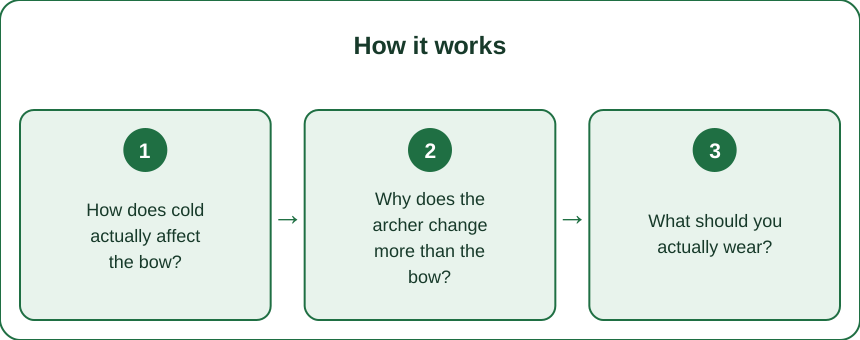
How does cold actually affect the bow?
Less dramatically than most archers assume, but consistently and in a predictable direction.
Limb performance drops slightly. Modern limb materials are relatively stable, but stored energy release is marginally lower in cold. Combined with denser cold air creating more drag, arrow speed drops a small amount - typically enough to move the point of impact down at longer distances.
Strings and cables stiffen and contract. This can change brace height very slightly, which changes tune. If you’ve made careful tuning adjustments in summer, expect them to be marginally off in winter conditions.
Lubricants thicken. On compound bows, any grease in cams or on axles becomes more viscous, which can affect draw cycle smoothness. Rest and sight mechanisms with fine adjustment threads can feel notably stiffer.
Arrow spine behaves fractionally differently with temperature, though the effect is small relative to everything else.
The practical response: expect a small downward shift at distance and confirm it rather than guessing. Shoot a sighting group at your longest regular distance on the first cold session of the season and record the adjustment. Write it in the same place every year - most archers rediscover the same number every autumn because they never wrote it down.
Why does the archer change more than the bow?
Because almost every element of a consistent release depends on fine motor control, and cold degrades exactly that.
Finger sensitivity drops. For recurve and barebow archers this is the single biggest factor. You cannot feel string pressure or the moment of release as precisely, and the release becomes less clean without you noticing.
Muscles are less compliant when cold, meaning your draw feels heavier and your back tension is harder to establish. Most archers respond by pulling with arms rather than back, which is exactly the fault they’ve spent months correcting.
Shivering is a control problem, not just discomfort. Even mild shivering introduces movement you cannot compensate for. If you’re shivering, the session’s technical value is essentially gone - which makes staying warm a training decision rather than a comfort one.
Reaction to cold shortens sessions and rushes shots. People shoot faster to finish sooner, and rushed shots build bad habits fast.
The order of priorities that follows from this: stay warm first, warm up longer second, adjust equipment third. Most archers do this in reverse.
What should you actually wear?
The clothing problem is specific in archery because anything on the string side of your body will eventually be hit by the string.
The string path is the constraint. Bulk on the chest, the bow arm, or the drawing forearm changes clearance and produces string slap, altered arrow flight, or worse groups without any obvious cause.
Layering that works:
- Base layer: thin, close-fitting, thermal. Merino or a technical synthetic. This is the layer doing the warmth work.
- Mid layer: a close-fitting fleece or thin insulated layer, fitted rather than roomy
- Outer: wind-resistant shell, worn only between ends if it’s bulky. Wind chill is the main enemy on an open range.
- Chest guard: essential in cold, and size it over your winter layers rather than your summer ones - a chest guard fitted to a t-shirt won’t do its job over a fleece.
- Arm guard: longer than your summer one if possible, since layers push the string path outward.
Hands - the hardest problem:
- Fingerless gloves or a shooting glove over a thin liner for the drawing hand
- A full mitten worn between ends, removed only to shoot; a chemical hand warmer in the pocket between ends is more effective than anything worn continuously
- A thin glove on the bow hand is usually fine and helps considerably
Feet matter more than expected. Standing still on cold ground for two hours drains core temperature. Insulated boots and a second pair of socks change how long a session stays useful.
5 Mistakes Everyone Makes in Cold-Weather Archery
1. Using the same warm-up as in summer. Cold muscles need 10-15 minutes of general movement plus stretch band work before the first arrow. Drawing a full-weight bow cold is a shoulder injury waiting to happen, and shoulder injuries in archery are slow to resolve.
2. Shooting the same volume. Session quality drops as you cool down. Fewer, better arrows beats more arrows - 40 focused shots is worth more than 80 shivering ones, and the 80 actively build faults.
3. Blaming form for a sight problem. Groups low at distance in cold is expected physics. Adjusting your form to compensate for a temperature effect is how a good technique gets dismantled over a winter. Adjust the sight, note the number, move on.
4. Wearing the summer chest guard over winter layers. It no longer covers what it needs to, and the resulting string contact produces inconsistent releases you’ll chase for weeks. This is the third mistake that catches even experienced archers, because nothing about it feels like a clothing problem.
5. Leaving the bow in a cold car and shooting immediately. Let equipment come closer to ambient temperature before shooting, and never draw a bow that’s been in freezing conditions without letting it settle - particularly with older limbs.
How do you keep progressing through the cold months?
Winter is a genuinely good training season if you use it for the right things.
What winter is good for:
- Form work at short distance. Blank bale shooting at 3-5 metres requires far less time standing still, keeps you warmer, and is the highest-value technical practice there is.
- Strength and stability work indoors. Rotator cuff, scapular stability, and general strength are what limit most archers, and they’re best trained away from the range.
- Stretch band drills at home. 10 minutes daily maintains the movement pattern with zero weather dependency.
- Equipment maintenance and tuning, done indoors and unhurried.
What winter is poor for: chasing personal bests at distance, making fine tuning changes you intend to keep, and long-volume sessions.
A workable cold-season structure:
- 1 outdoor session per week, shorter and warmer than summer, focused on a specific goal
- 1 indoor or short-distance session for form
- 2-3 short band sessions at home
- 2 strength sessions targeting shoulders and back
Archers who follow something like this consistently come out of winter shooting better than they went in, while those who simply shoot less come out having lost ground. The difference isn’t dedication - it’s picking practice that the weather can’t take away.
FAQ: Cold-Weather Archery Questions, Answered
How much will my point of impact actually shift?
It varies by setup and distance, and it’s usually small - noticeable at 50m and above, minor at 18m. Rather than using a general figure, shoot a group and record your own number for your own bow.
Should I use a different arrow in winter?
Usually not necessary for recreational and club shooting. Competitive archers shooting long distances sometimes adjust, but for most people the sight adjustment covers it.
Is it bad for my bow to be stored in the cold?
Storage in cold isn’t generally harmful for modern equipment, but repeated cycling between very cold and warm humid indoor air can cause condensation on metal parts. Wipe the bow down when you bring it in, and store it dry.
What about shooting in rain versus cold?
Rain is harder on equipment and easier on the archer; cold is the reverse. Wet strings and rests need attention afterwards, but your hands still work. If you have to pick a session to skip, skip the very cold one.
TL;DR:
- Cold shifts point of impact slightly downward at distance - measure your own number and record it
- The archer degrades faster than the bow; finger sensitivity and back tension are the first to go
- Layer close-fitting, and size your chest guard over winter layers, not summer ones
- Warm up 10-15 minutes before the first arrow and shoot fewer, better shots
- Use winter for short-distance form work, band drills, and strength - not for chasing distance scores
The archers who improve over winter aren’t the ones who tough it out at 70m in a gale. They’re the ones who moved the useful practice somewhere the weather couldn’t reach it.
Keep Reading
This article is for general informational and styling purposes only. Fit, sizing, and product availability may vary.