Cross-Eye Dominance in Archery: Why Your Groups Wander and What To Do About It
Quick Answer: Roughly a third of people have an eye dominance that does not match their handedness, and in archery that mismatch produces exactly the symptom people misdiagnose as inconsistent form - groups that wander horizontally, a sight picture that shifts, and an inability to explain a good day versus a bad one. Test it in ten seconds with the triangle test. Then choose one of three fixes: switch to shooting on your dominant-eye side, occlude the dominant eye with tape or a blinder, or close it. Switching sides is best done early; occluding is the pragmatic option for anyone already established.
Your form is consistent. Your anchor is consistent. Your arrows are not. Before you spend another month adjusting your release, spend ten seconds finding out which eye is actually running the show.

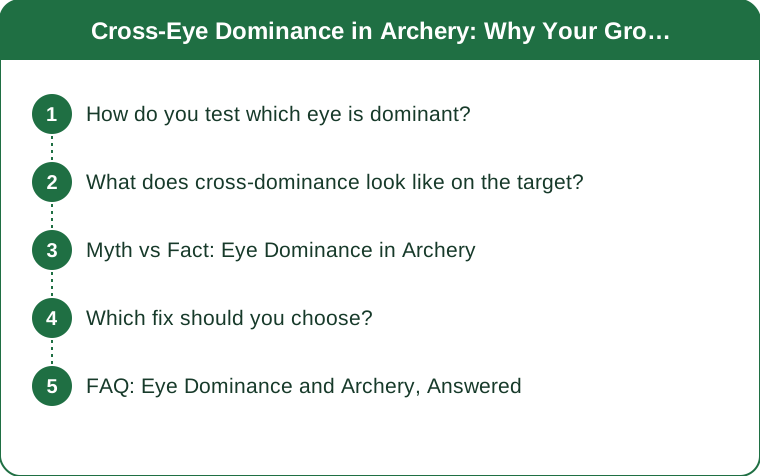
How do you test which eye is dominant?
The triangle test takes ten seconds. Extend both arms, overlap your hands to make a small triangular opening, and with both eyes open, frame a distant small object through the hole. Now close one eye, then the other. The eye that still sees the object through the triangle is your dominant eye. The one where the object disappears is not.
Do it three times to be sure, at different distances. Some people have a weak or variable dominance rather than a clear one, and the answer changes with distance and fatigue. That variability is itself useful information - it usually means occluding or closing an eye is a better solution than relying on natural dominance.
A second check: the point test. Point at a distant object with both eyes open, then close each eye. The eye that keeps your finger on target is dominant.
Understand what dominance actually is. Both eyes see the target; the brain uses one eye’s input preferentially for alignment. When you aim with the non-dominant eye, your brain keeps trying to reference the other one, which is why the sight picture can seem to shift or double.
And know that it is common. Cross-dominance - right-handed with a left dominant eye, or the reverse - occurs in a substantial minority of people, which means a meaningful fraction of any beginner archery class is fighting this without knowing. It is not a defect and it is entirely workable.
What does cross-dominance look like on the target?
Horizontal wandering more than vertical. Eye dominance affects lateral alignment specifically, so the classic signature is groups that spread left and right while vertical grouping stays reasonable. Vertical spread has other causes - release, anchor height, bow arm.
A consistent lateral offset that resists sight adjustment. You move the sight, the group moves, but the inconsistency does not improve. That is a strong hint that the problem is in how you are aiming rather than where.
A sight picture that seems to jump. Archers describe the pin or the arrow point appearing to shift position, or seeing a ghost image. That is your brain switching reference eye mid-aim, and it is the most diagnostic symptom there is.
Good days and bad days with no explanation. Eye dominance strength varies with fatigue, light conditions, and how hard you are concentrating. On days when the non-dominant eye holds control, everything works; on days when the dominant eye takes over, it does not. This is the frustration pattern that sends people looking for equipment answers.
And worse performance with both eyes open than with one closed. If closing one eye suddenly makes everything better, you have your answer without any further testing. Many archers discover this accidentally and never understand why it worked.

Myth vs Fact: Eye Dominance in Archery
Myth: You should always shoot on your dominant hand side. Fact: For archery, eye dominance generally matters more than hand dominance, because aiming is a visual alignment task and the draw is trainable. Many coaches will switch a beginner to the dominant-eye side specifically for this reason.
Myth: It is too late to switch sides once you have started. Fact: Harder, not impossible. Switching in your first weeks costs very little; switching after years of established form costs a season. The decision point is usually how early you are and how serious your goals are.
Myth: Just close the non-shooting eye and it is solved. Fact: Closing one eye works and has costs - it reduces depth perception, can cause squinting tension that affects the face and anchor, and tires the eye over a long session. Occluding with tape on glasses or a blinder achieves the same effect while both eyes stay open and relaxed.
Myth: Eye dominance is fixed forever. Fact: It is generally stable but can be weak, variable, or shift with age, eye conditions, or fatigue. If your results changed and your form did not, retesting dominance is a reasonable check.
Myth: This only affects beginners. Fact: Experienced archers with weak or variable dominance often live with an unexplained inconsistency for years. It is one of the more commonly missed explanations for a plateau in accuracy.
Which fix should you choose?
Switch sides if you are new. If you have been shooting for a few weeks or months and you are cross-dominant, switching to the dominant-eye side is usually the best long-term answer. It feels awkward for a fortnight and then it feels normal, and you have removed the problem permanently rather than managing it. Costs: possibly a new bow if yours is handed.
Occlude the dominant eye if you are established. A small piece of translucent tape on the lens of shooting glasses over the dominant eye, or a clip-on blinder, blocks that eye’s view of the target while leaving both eyes open. This is the standard solution and it is what most cross-dominant archers use. Translucent rather than opaque is generally preferred, because it blurs rather than fully blocks, which is more comfortable and less disorienting.
Close the eye if you want a free, immediate fix. It works. It is what most people do instinctively. The downsides - facial tension, fatigue, reduced peripheral awareness - are real but manageable for shorter sessions.
Do not try to force dominance to switch by willpower. Some archers report training a shift over long periods, but it is unreliable and slow, and there are two straightforward alternatives.
Whatever you choose, be consistent. Alternating between closing an eye on some ends and not on others reintroduces exactly the variability you were trying to remove. Pick a method and use it every single shot.
And tell your coach. A coach diagnosing inconsistent groups without knowing about cross-dominance will spend weeks working on your release. It is the first thing worth mentioning at a first lesson, and one of the most common things beginners never think to raise.
FAQ: Eye Dominance and Archery, Answered
How do I find my dominant eye?
Make a small triangle with your overlapped hands, frame a distant object with both eyes open, then close each eye in turn. The eye that still sees the object through the opening is dominant. Repeat it a few times at different distances to check for weak or variable dominance.
Should I shoot based on my dominant hand or my dominant eye?
For archery, eye dominance generally takes priority because aiming is a visual alignment task while the draw is trainable. Beginners are frequently switched to their dominant-eye side for exactly this reason.
Is it too late to switch sides?
It is much easier in the first weeks and considerably harder after years of established form. If you are past that point, occluding the dominant eye with translucent tape or a blinder achieves the same result without rebuilding your technique.
Why do my arrows scatter left and right but not up and down?
Horizontal scatter is the classic signature of an eye dominance conflict, because dominance affects lateral alignment specifically. Vertical spread usually points to release, anchor height, or bow arm instead.
TL;DR:
- Cross-dominance - dominant eye on the opposite side from your bow hand - is common and produces horizontal group scatter that resists sight adjustment.
- Test it in ten seconds with the triangle test, and repeat a few times to check whether your dominance is strong or variable.
- The telltale symptoms are a sight picture that seems to shift, unexplained good and bad days, and shooting better with one eye closed.
- Switch to the dominant-eye side if you are new; occlude the dominant eye with translucent tape or a blinder if you are established.
- Whichever method you pick, use it on every shot - alternating reintroduces the exact inconsistency you were solving.
If your form is solid and your arrows still wander sideways, the problem may not be in your hands at all. Ten seconds of testing is worth more than another month of adjusting your release.
Keep Reading
This article is for general informational and styling purposes only. Fit, sizing, and product availability may vary.