How to Actually Practice Archery Fundamentals Without Access to a Range
Quick Answer: You can genuinely practice archery at home — form checks in a mirror, anchor point repetition, back tension with a resistance band, mental rehearsal, and supporting strength work all transfer. What doesn’t transfer is aiming at real distance, arrow flight feedback, wind adjustment, and shooting-volume endurance. Never dry fire an actual bow — releasing the string with no arrow can destroy the bow and injure you. Use a resistance band or a purpose-made training device instead.
The honest problem with learning archery is that most instruction assumes you can get to a range whenever you like. Real life offers you a Saturday morning every other week, if the weather cooperates.
So the useful question isn’t “how do I practice at home instead of the range.” It’s: which parts of archery are actually range-dependent, and which parts have you been wasting range time on?

First: the safety rule that comes before everything
Do not dry fire a bow. Drawing and releasing a bowstring with no arrow on it sends all the stored energy back into the limbs instead of into an arrow. Compound bows can shatter. Recurve limbs can crack. People get hurt, and the bow is often written off.
So when archers say “dry fire practice,” what’s meant here is form work without releasing — drawing to anchor and letting down under control — or working with a resistance band or a purpose-built training device that’s designed for it.
If you’re brand new: get supervised instruction at a range or with a coach before you practice anything at home. You need someone to confirm your draw length, your bow’s draw weight, and your basic safety habits first. Home practice sharpens correct technique; it also cements incorrect technique with equal efficiency.
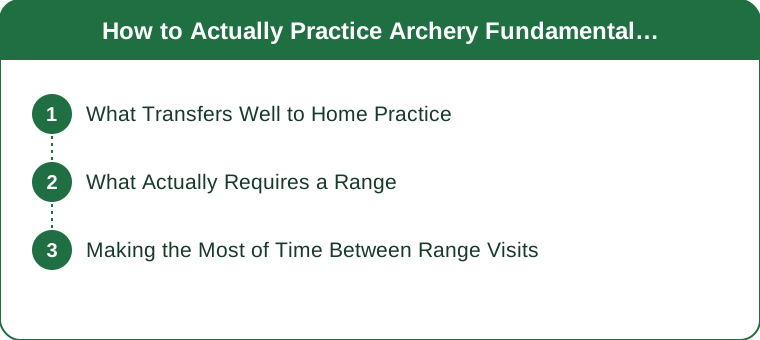
What genuinely transfers to home practice
1. Form checks in a mirror. Draw to anchor, hold, and check: stance width, hip and shoulder alignment, draw elbow height, bow arm shoulder staying down rather than shrugging up. Then let down under control. No release, no arrow. This is real practice and it costs you nothing.
2. Anchor point consistency. The single biggest source of inconsistency for developing archers is an anchor point that moves. The fix is repetition — same spot on your face, every time, until you don’t have to think about it. Ten sets of draw-hold-let down, three times a week, builds that faster than a fortnightly range session ever will.
3. Back tension with a resistance band. A light resistance band anchored at eye level lets you rehearse the pull-through-the-back pattern — scapular retraction driving the draw, rather than pulling with the arm. This is the technique most beginners get wrong and the one a band trains almost perfectly. 3 sets of 10 slow pulls.
4. Mental rehearsal. Visualizing a full shot sequence, in order, in real time. Motor-learning research supports mental practice as producing genuine carryover to physical skill — not as a replacement for physical practice, but as a meaningful supplement. Five minutes, eyes closed, running the sequence from stance to follow-through.
5. Supporting strength. Holding a bow at full draw is a shoulder-stability and postural-endurance task. Face pulls, band pull-aparts, rows, and core work directly improve how long you can hold a clean position. 2–3 short sessions a week.
That’s a substantial list. It’s not a consolation prize — it covers most of what actually limits a developing archer.

What genuinely requires a range
Aiming at real distance. Sight picture and target focus depend on actual distance and actual target size. No living-room setup replicates the visual problem of a target 18 or 70 meters away.
Arrow flight feedback. Where the group lands tells you things nothing else can — about your release, your form under load, your equipment tune. There’s no substitute for watching arrows hit.
Environmental adjustment. Wind reading, light conditions, uneven ground. These exist only outdoors, at a range.
Shooting-volume endurance. The fatigue pattern of 60 real arrows in a session is different from 60 let-downs. Grip fatigue, shoulder endurance, and the concentration drift that shows up at arrow 40 all need real volume.
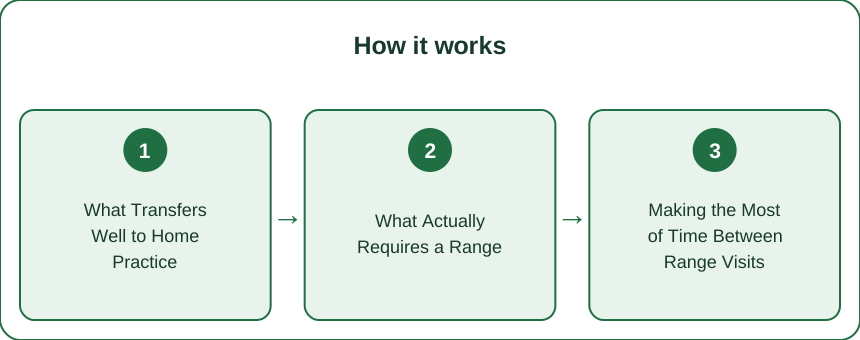
What nobody tells you about practicing between range visits
Most people waste their range time. They arrive, spend the first 20 minutes rebuilding form they let slip, and then shoot tired. If form and anchor were maintained at home, that whole first block converts into productive shooting.
Frequency beats duration for motor memory. Ten minutes of form work five days a week does more for consistency than one 50-minute home session. Motor patterns consolidate through repeated exposure, not through marathon blocks.
Letting down is a skill in itself. Learning to draw, decide not to shoot, and come down under control is genuinely useful at the range — it’s how you abort a bad shot instead of forcing it. Home practice trains this constantly.
A resistance band is the highest-value $10 in archery. Most of the home practice list runs off one band. Purpose-built draw trainers exist and are good, but the band gets you most of the way.
You will plateau at home, and that’s the correct signal. When form work stops feeling like it’s changing anything, you need arrows. Home practice maintains and refines; the range is where progress gets measured and where new problems reveal themselves.
The practical split
On non-range days: 10–15 minutes. Five minutes of mirror form and anchor repetition, five minutes of band work, five minutes of mental rehearsal. Three to five days a week.
On range days: don’t spend the session re-learning basics. Go straight to aiming, grouping, distance work, and volume — the things only the range provides.
Keep a one-line log. After each range visit, write down whether the anchor felt more consistent than last time and where the groups sat. Two sentences. This is what connects your home work to actual results, and without it you’re guessing about whether any of it is helping.
Set honest expectations. No amount of home practice replaces range time. What it does is make range time more valuable and stop the between-visit decay. Expecting range-level progress from living-room sessions is the fastest route to giving up.
Safety, again, briefly
Never dry fire a bow. Never draw a bow indoors with an arrow nocked. Confirm your draw weight is appropriate before doing high-repetition draw work — overbowing is the most common cause of shoulder injury in new archers, and repetition multiplies it. If you feel shoulder pain during draw work, stop and get it assessed rather than pushing through.
FAQ
Can you learn archery at home?
You can learn and maintain a large portion of the fundamentals at home — form, anchor consistency, back tension, mental sequence, and supporting strength. But you can’t learn to shoot accurately at home, and a complete beginner should get supervised instruction before practicing alone, so that home repetition reinforces correct technique rather than baking in errors.
Is dry firing a bow ever safe?
No. Releasing a bowstring without an arrow can crack limbs, destroy a compound bow, and cause injury. When archers talk about home “dry fire practice” they mean drawing and letting down without releasing, or using a resistance band or purpose-made draw trainer.
How often should I practice archery at home?
Short and frequent works best: 10–15 minutes, 3–5 days a week. Motor consistency comes from repeated exposure rather than long sessions, and short blocks are much more likely to survive a busy week.
TL;DR:
- Never dry fire an actual bow — use a resistance band or a purpose-made draw trainer.
- Transfers to home: mirror form checks, anchor repetition, back tension with a band, mental rehearsal, supporting strength.
- Requires a range: real-distance aiming, arrow flight feedback, wind and conditions, shooting-volume endurance.
- Beginners need supervised instruction first, so home reps reinforce good form rather than bad.
- 10–15 minutes, 3–5 days a week beats one long session — frequency drives motor memory.
- Reserve range time for shooting, not for rebuilding form you could have maintained at home.
- Keep a two-line log after each range visit connecting home practice to actual groups.
Keep Reading
This article is for general informational and styling purposes only. Fit, sizing, and product availability may vary.