The One-Sided Strength Problem Every Archer Eventually Notices
Quick Answer: Archery builds real left-right asymmetry because the bow arm holds a sustained isometric push while the draw arm and back do a repeated pull — two different jobs, hundreds of times per session. Watch for uneven shoulder height in the mirror, one side fatiguing faster, and tightness that always lands on the same side. The fix is deliberate off-range work: strengthen the underused bow side, mobilize both sides, and build general core and upper-back strength. This is general information, not medical advice.
Nobody starts archery worried about their shoulders. You start worried about your groups.
Then somewhere around month six you catch yourself in a mirror and one shoulder is sitting visibly lower than the other, and you realize the sport has been quietly reshaping you the whole time.

Why Does Archery Cause Muscle Imbalance?
Because the two arms are doing completely different jobs on every single shot — by design, not by mistake.
The bow arm works in sustained stabilizing isometric tension. It pushes, holds a fixed position, and resists movement. The draw arm and the draw-side back work in a pulling pattern — a dynamic contraction through the rhomboids, mid-traps, and rear delt, held at anchor, then released.
Proper back tension technique makes this more pronounced, not less. Good form deliberately loads the draw-side back with every shot, which is exactly what you want for accuracy and exactly what produces the asymmetry.
Then volume does the rest. A practice session might run 100–300 arrows. A small per-shot difference multiplied by 200 repetitions, three times a week, for six months, is no longer small.
And unlike most sports, there’s no mirrored version. A tennis player at least serves and returns; a swimmer alternates. An archer shoots one way, every time, forever. Nothing in the sport itself offsets it.
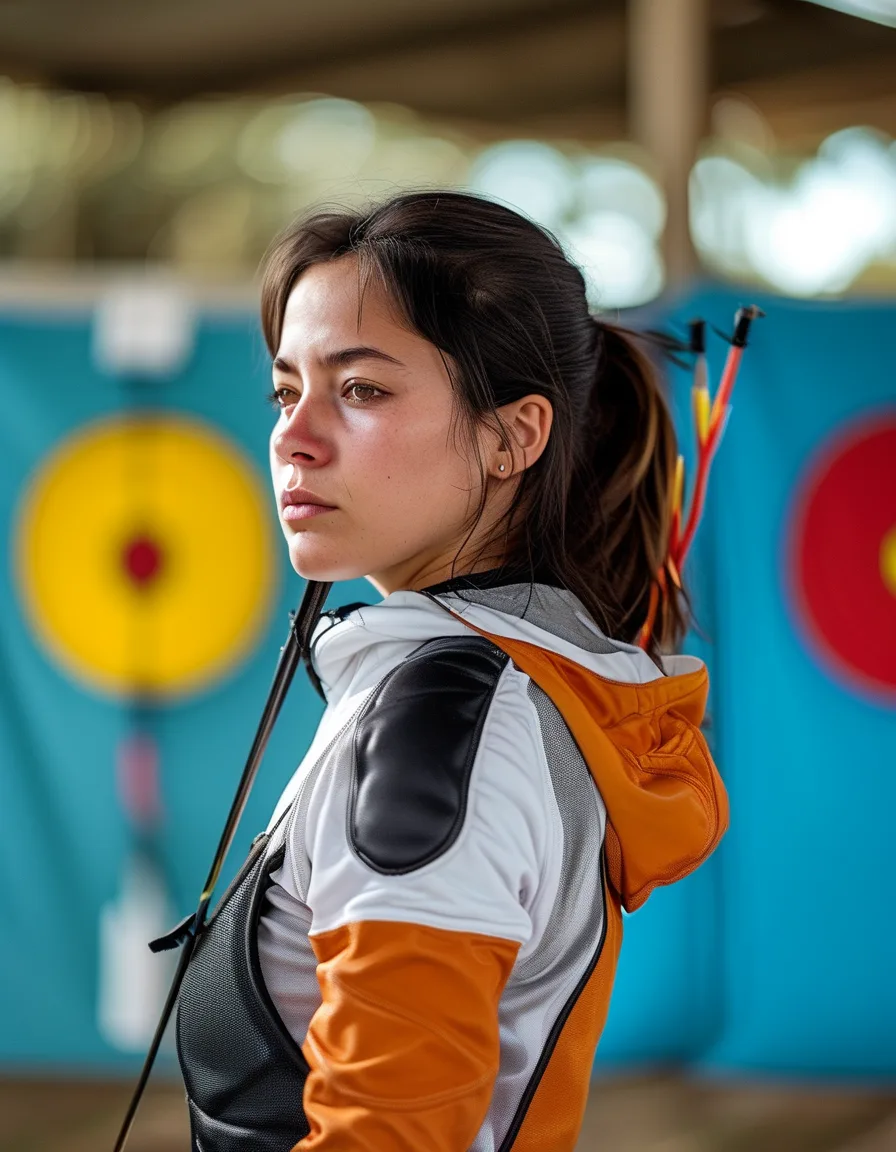
How Do You Spot It Early?
Four signals, and they show up in roughly this order:
1. The mirror check. Stand relaxed — genuinely relaxed, not “posture” relaxed — in front of a mirror. Does one shoulder consistently sit higher, or rolled further forward? Take a photo every month rather than trusting your memory; the drift is gradual enough that you won’t notice it day to day.
2. Disproportionate fatigue. Your draw side should tire before your bow side — that’s normal. What’s not normal is your draw side quitting halfway through a session you used to finish comfortably.
3. Posture drift off the range. A subtle lean or rotation appearing in how you stand in line at the store or sit at your desk. This is the clearest sign the pattern has generalized beyond the sport.
4. Tightness that always lands on the same side. Recurring stiffness in the same shoulder, the same trap, or the same spot along the spine after every session. Occasional soreness is training; a fixed location every time is a pattern.
A quick self-test: do a wall angel or a simple overhead reach and compare sides. If one arm gets flatter against the wall than the other, or one reaches noticeably further, you’ve found your asymmetry.
What Balancing Work Actually Helps?
The work happens off the range, because more shooting only reinforces the pattern.
Strengthen the underused side deliberately. The bow-side shoulder and back need the pulling work they never get. Single-arm rows, single-arm lat pulldowns, and unilateral rear-delt work on the bow side specifically. Doing them bilaterally doesn’t fix it — the strong side just takes over. Extra volume on the weak side is the point: try two sets on the bow side for every one on the draw side.
Mobilize both sides, but differently. The tight side usually needs length; the other side often needs stability. Applying identical stretching to both can widen the gap rather than close it. Thoracic rotation, pec stretches, and lat stretches on both sides, with extra attention wherever the restriction actually is.
Build the center. General core and upper-back strength limits how far an arm asymmetry can spread into your spine and hips. Anti-rotation work — Pallof presses, suitcase carries on the weaker side — is especially relevant here, because it directly trains the thing archery keeps unbalancing.
Frequency: two to three short sessions a week, 15–20 minutes, is enough. This is maintenance work, not a second sport.
When to see a professional: if you have pain rather than just tightness, numbness or tingling down an arm, a visible drop in one shoulder that doesn’t respond to a couple of months of balancing work, or any loss of range of motion, get assessed by a physical therapist — ideally one who’s worked with overhead or unilateral athletes. Asymmetry is normal; pain isn’t.
5 Mistakes Everyone Makes With This
- Waiting until it hurts. By the time there’s pain, the imbalance has been building for months. The mirror check costs 10 seconds.
- Training both sides equally in the gym. Symmetric training on an asymmetric body preserves the asymmetry. You have to overload the weak side.
- Stretching only the tight side. Tightness is often a stability problem wearing a mobility costume. Stretching a side that’s already unstable can make it worse.
- Shooting more to “even it out.” More arrows means more of the same pattern. The offset has to come from outside the sport.
- Skipping the core work because it doesn’t feel related. The spread of an arm imbalance into your whole posture runs straight through your trunk. That’s where you stop it.
FAQ
Is muscle imbalance from archery dangerous?
Mild asymmetry is normal in any unilateral sport and isn’t inherently harmful. It becomes a problem when it produces pain, restricted movement, or posture changes that persist off the range. Consistent off-range balancing work keeps it in the harmless range.
How often should archers do balancing exercises?
Two to three sessions a week of 15–20 minutes is enough for most recreational archers. Competitive archers shooting high volume should treat it as a permanent part of training rather than something to do when symptoms appear.
Should I practice shooting with my other hand?
Some archers do, and it can help — but it’s slow to learn, awkward, and takes range time away from your actual practice. Targeted gym work on the bow side gets the same balancing effect far more efficiently.
TL;DR
- The bow arm holds isometrically, the draw arm pulls — different jobs, hundreds of reps per session.
- No mirrored version exists in the sport, so nothing offsets it naturally.
- Early signs: uneven shoulders in the mirror, one side fatiguing faster, posture drift off the range, same-side tightness every time.
- Fix it off the range: overload the bow side, mobilize both sides differently, build core and upper back.
- 15–20 minutes, 2–3x a week is enough.
- Pain, numbness, or lost range of motion means see a physio, not more reps.
Keep Reading
This article is for general informational and styling purposes only. Fit, sizing, and product availability may vary.