Arrow Spine, Explained: Why the Right Arrows Fix Groupings the Best Form Cannot
Quick Answer: Arrow spine is how much an arrow shaft bends under the force of the shot, and it has to be matched to your draw weight, draw length, point weight, and bow type. Too stiff and the arrow kicks one direction off the riser; too weak and it kicks the other. Because the mismatch is consistent, it produces a repeatable group in the wrong place or a persistent left-right spread that looks exactly like a form fault. Get the spine right and a surprising number of accuracy problems disappear without changing anything you do.
You fixed your anchor, you fixed your grip, you fixed your release, and your groups are still frustrating. This is the variable sitting between the bow and the target that nobody mentions in a beginner lesson.

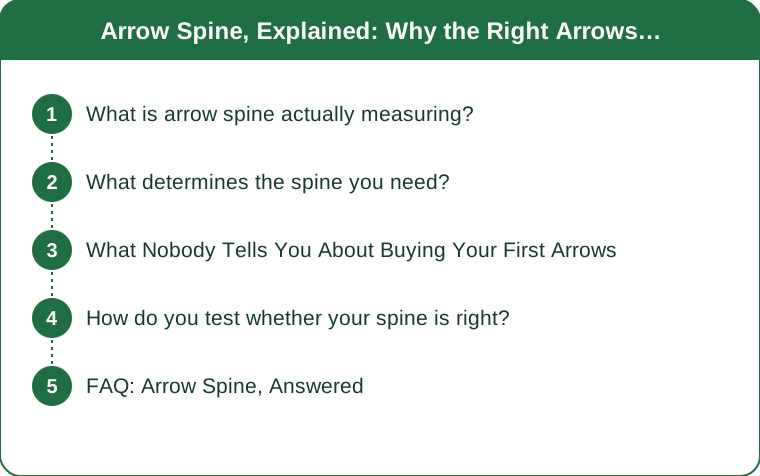
What is arrow spine actually measuring?
Spine is stiffness, expressed as a deflection number. The standard test suspends a shaft between two supports a set distance apart, hangs a defined weight from the middle, and measures how far the center sags. A shaft that sags 0.500 inches is a 500 spine; one that sags 0.340 inches is a 340. Counterintuitively, the bigger the number, the weaker the shaft.
Arrows bend a lot more than people expect. At the shot, the string pushes the back of the arrow forward while the mass of the point resists, and the shaft buckles into an S-curve. This is the archer’s paradox - the arrow flexes around the riser rather than going through it, then oscillates itself straight over the first several yards of flight.
The flex has to be tuned, not eliminated. A perfectly rigid arrow would slap the riser and deflect badly. The goal is a shaft that bends the right amount at the right moment so it clears the bow cleanly and settles into straight flight quickly.
Too stiff and it does not bend enough to clear. For a right-handed archer shooting a recurve off the shelf or a plunger, an over-spined arrow typically groups to the left. Too weak and it over-bends, clearing awkwardly and typically grouping right. For left-handed archers, reverse both.
The critical point for diagnosis: this error is consistent. A form fault produces scatter. A spine mismatch produces a tight group in the wrong place or a repeatable directional bias. If your arrows are landing consistently to one side but grouping reasonably well, look at equipment before you rebuild your release.
What determines the spine you need?
Five things, and changing any of them changes the answer.
Draw weight at your draw length. This is the biggest factor and the one people get wrong most often. A bow marked 30 pounds is marked at a 28-inch draw. If you draw 26 inches you are pulling meaningfully less than 30; if you draw 30 inches you are pulling meaningfully more - typically around 2 to 3 pounds per inch on a recurve. Use your actual weight at your actual draw, not the number on the limb.
Draw length, again, separately. A longer arrow of the same shaft is effectively weaker, because a longer beam bends more easily. Every inch of extra arrow length shifts the effective spine noticeably.
Point weight. Heavier points make an arrow behave weaker, since more mass at the front means more resistance and more bend. This is the easiest variable to change and the main tuning lever once you own a set of shafts - moving from a 100-grain to a 125-grain point is a real adjustment.
Bow type and cut. A recurve cut past center, a recurve cut to center, a longbow shot off the knuckle, and a compound with a full containment rest all demand different spines at the same draw weight. Traditional bows shot off the shelf are the most spine-sensitive of all because the arrow must bend around the riser rather than pass through a cutout.
String material and setup. A fast, low-stretch string transmits energy more abruptly, which effectively requires a slightly stiffer arrow. Adding brass nocking points or heavy string silencers has a small effect in the other direction.
In practice: use the manufacturer’s spine chart as your starting point. Every shaft maker publishes one, they are not interchangeable between brands, and they encode all of the above. Find your draw weight row and your arrow length column, and start there.

What Nobody Tells You About Buying Your First Arrows
The arrows in the beginner course were probably wrong for you. Club arrows are bought in bulk in a mid-range spine to be shootable by everyone. They are a compromise by design. Plenty of beginners plateau on club arrows and conclude they have hit their skill ceiling.
Buy arrows for the bow you will have in six months. Beginners commonly increase draw weight substantially in the first year. Buying arrows perfectly matched to a 24-pound starter limb means buying again in four months. Ask your coach where you are likely to be and consider building slightly long, since a long arrow can be cut shorter later - but a short arrow can never be lengthened.
Leave arrows long and cut them progressively. This is the single best piece of practical advice in arrow buying. Order shafts at your full uncut length, shoot them, and have them trimmed in small increments to tune. Cutting shortens and therefore stiffens the arrow, so you can walk the spine in from the weak side. Going the other direction requires new arrows.
Point weight is your free tuning knob. Once you own shafts, changing points is far cheaper than changing arrows and shifts effective spine meaningfully. Buy a couple of point weights when you buy the shafts.
Consistency between arrows matters more than perfection of any one. A matched set of twelve arrows that are all slightly off-spine will outgroup a mixed bag of twelve theoretically correct arrows from different batches. Weigh and label your arrows; keep the closest ones as your competition set.
And a slightly weak arrow is more forgiving than a slightly stiff one for most beginners, particularly on traditional setups, because it clears the riser more easily. If you are between two spines on the chart and shooting off the shelf, the weaker option is usually the safer first purchase.
How do you test whether your spine is right?
Start with bare shaft tuning, the standard method. Shoot three fletched arrows and one identical unfletched shaft at a target from about 10 to 15 yards. Fletching masks spine problems by correcting flight; a bare shaft cannot hide.
Read the result by where the bare shaft lands relative to the fletched group. For a right-handed archer: bare shaft left of the group suggests the arrow is too stiff; bare shaft right of the group suggests too weak. Reverse for left-handed. Bare shaft high or low points at nocking point height rather than spine.
Shoot enough arrows to be sure. Three bare shafts, three times, at a distance you can shoot consistently. One bare shaft off to the left tells you nothing except that you shot one arrow.
Then adjust in this order: point weight first, since it costs nothing and is reversible; then arrow length, cutting in quarter-inch increments; then plunger tension or rest position if your bow has one; and only then buy different shafts.
Do it at a distance you shoot well. Bare shaft tuning at 30 yards when your groups at 30 yards are already the size of a dinner plate produces noise, not information. Ten yards is plenty for the initial read.
And do it on a day when your form is stable. Tuning while you are also fighting a form issue produces conclusions that will be wrong by next week. If you are mid-way through changing your anchor or release, finish that first.
One caution worth stating plainly: a badly under-spined arrow is a safety issue, not just an accuracy one, because an arrow that flexes far beyond its design can fail. Never shoot arrows dramatically under-spined for your draw weight, and never shoot a carbon arrow you have not flexed and inspected for cracks before use.
FAQ: Arrow Spine, Answered
What happens if my arrow spine is wrong?
You get consistent flight problems rather than random ones - a repeatable left or right bias, poor arrow flight visible as fishtailing, inconsistent grouping at distance, and sometimes contact noise off the riser. Because it is consistent, it is frequently misdiagnosed as a form fault.
Does a higher spine number mean a stiffer arrow?
No, the opposite. Spine numbers describe deflection, so a 500 spine bends more than a 340 spine. Higher number means weaker shaft. This trips up nearly every beginner at least once.
Can I use the same arrows if I increase my draw weight?
Up to a point. A few pounds is often absorbed by reducing point weight or the natural tolerance of the setup, but a jump of five pounds or more usually needs a stiffer shaft. Check the manufacturer’s chart at your new weight before assuming.
Do I need different arrows for a recurve and a compound?
Usually yes. Compounds generally require stiffer arrows at the same nominal draw weight due to the different energy delivery, and the arrow does not need to bend around the riser in the same way. Never assume a set tuned for one bow will fly correctly from the other.
TL;DR:
- Spine is how much an arrow bends under the shot, and a higher spine number means a weaker shaft.
- It has to be matched to your actual draw weight at your actual draw length, plus arrow length, point weight, and bow type.
- A spine mismatch produces a consistent directional bias that is easily mistaken for a form fault - scatter is form, consistent offset is often equipment.
- Buy shafts long and cut progressively, and use point weight as your free tuning knob.
- Bare shaft tune at 10 to 15 yards on a day your form is stable, and adjust point weight, then length, then rest, before buying new arrows.
Form gets all the attention because it is the part you can practise. But if the arrow leaving the bow is fighting the bow itself, no amount of practice fixes it - and matching the spine is the cheapest accuracy upgrade in the sport.
Keep Reading
This article is for general informational and styling purposes only. Fit, sizing, and product availability may vary.